Pokédex Explorer
Search through over 1,000 Pokémon, uncover their types, stats, abilities, and evolution chains in seconds.
Explore detailed information on over 1000 Pokémon. Search by name, type, or ability. Your journey to become a Pokémon Master starts here.
Whether you are a casual fan or a battle expert, there is always a new Pokémon mystery to explore.
Search through over 1,000 Pokémon, uncover their types, stats, abilities, and evolution chains in seconds.
Test your knowledge with fast-paced Pokémon quizzes that mix generations, moves, and classic characters.
Challenge yourself alone or compete with friends in local and online games built for quick, addictive rounds.
Track how the world changed from Kanto to Paldea and discover the unique identity of each region.
Every generation brings a fresh region, a new cast of monsters, and a new chapter in the Pokémon journey.
1996–1999
1999–2002
2002–2006
2006–2010
2010–2013
2013–2016
2016–2019
2019–2023
2023–present
A pocket-sized dream that somehow took over the entire planet. Here's how it happened.
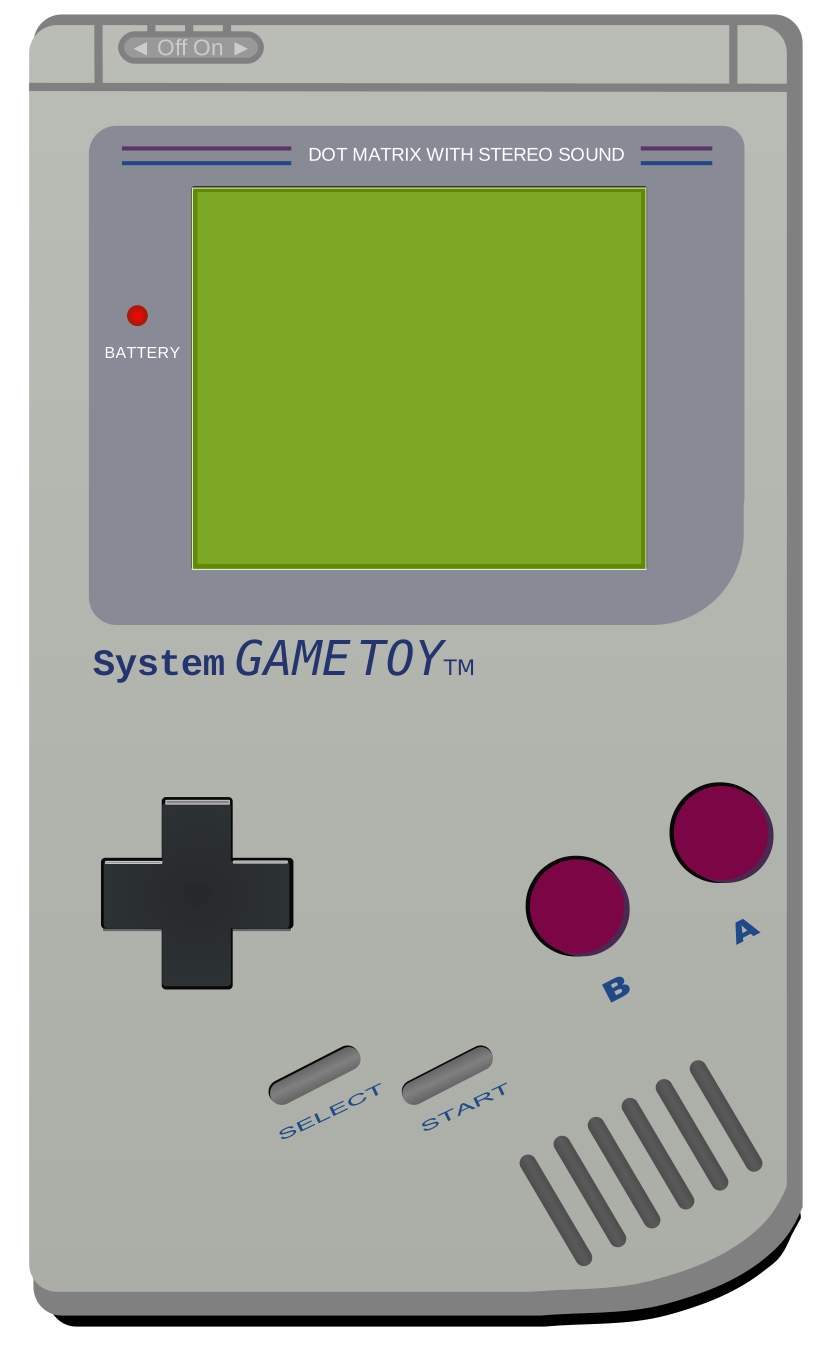
Imagine spending a whole recess explaining to your friend why Gengar evolves from Haunter via trade, not level up. That was 1996. You chose Charmander, your best friend chose Squirtle, and neither of you would ever be the same. The Game Boy's green-tinted screen somehow made Mt. Moon feel enormous and mysterious. Every wild Pokémon encounter was a tiny heart attack. Every badge earned felt like a trophy. The franchise had no idea it was about to take over the world.
Nothing prepared you for the first time you plugged your cartridge into the Transfer Pak and watched your own Pokémon walk onto a Stadium arena in full 3D. That Charizard you'd spent 80 hours raising? It roared at the screen. The ground shook. You screamed. Pokémon Stadium turned your bedroom into a proper battle arena — and the rental cup taught a whole generation what it meant to strategize under pressure with six random Pokémon and no items.
They said you couldn't top Red and Blue. Then Pokémon Gold and Silver arrived and casually handed you a real-time clock, a phone that rival trainers could call to challenge you again, and — buried at the very end — the entire original Kanto region as a bonus second act. The Game Boy Color made Pokémon actually look like they belonged in the future. Totodile, Cyndaquil, Chikorita: a new trio that split friend groups all over again.
The theme song plays. You immediately stop whatever you're doing. That was the power Pokémon had in 1998. Ash and Pikachu turned into a global phenomenon almost overnight — kids who had never touched a Game Boy were suddenly obsessed. Misty's bike never got repaid. Team Rocket's Meowth learned to talk and somehow became the most compelling character in the show. Mewtwo Strikes Back made children cry in the cinema. The anime wasn't just a tie-in. It was a cultural force of its own.
Pokémon Ruby and Sapphire dropped you into a tropical archipelago and immediately handed you abilities, double battles, and a secret base you could furnish and share with friends. Emerald followed with the Battle Frontier — a post-game so deep that veteran trainers are still talking about it today. The GBA's vivid screen gave Pokémon a color palette they'd never had before, and Kyogre vs. Groudon made the legendary battles feel genuinely apocalyptic. Hoenn was divisive at launch. Now everyone admits it was a masterpiece.
Forget cheerful routes and friendly gym leaders. Pokémon Colosseum dropped you into the dust-blown desert region of Orre — a lawless wasteland with no wild Pokémon, only criminals, and a mechanic called Shadow Pokémon that forced you to steal corrupted creatures from their evil trainers and purify their hearts. It felt nothing like the main series. It was darker, more cinematic, and oddly emotional. XD: Gale of Darkness pushed it further. These games proved Pokémon could carry a serious narrative — fans have never forgotten them.
Eight years after Red and Blue, Game Freak brought Kanto back on the GBA and made it look like it had always deserved to. FireRed and LeafGreen weren't lazy remakes — they added the Sevii Islands, a proper regional Pokédex, and wireless adapter support that made trading feel magical again. If you'd grown up with the originals, replaying Lavender Town with a proper sound chip and full color was something close to time travel. A whole new generation met Kanto for the first time here, and they had no idea how lucky they were.
Two screens. A touch panel. And then one afternoon someone told you about the GTS — the Global Trade System — and suddenly you were negotiating a Dialga for a Palkia with a trainer in Tokyo at midnight. The Underground had entire communities of players digging up fossils and setting up flag-stealing raids with the people sleeping in the same house as you. Platinum refined it all into something close to perfect. HeartGold and SoulSilver then remade Gold and Silver so lovingly that grown adults openly wept.
Pokémon Battle Revolution let you connect your DS cartridge to the Wii and watch your actual team fight in fully animated HD for the first time — and the crowd in the stadium actually reacted. My Pokémon Ranch gave you a virtual field where your Pokémon could roam around and interact with Miis, which sounds simple but felt oddly wholesome and comforting. The Wii era wasn't the flashiest chapter in Pokémon history, but it made your team feel real in a way nothing had before.
Unova arrived with a Pokédex full of Pokémon you’d never seen, forcing you to fall in love with a whole new cast from scratch. Then N walked on screen and quietly dismantled everything you thought you knew about being a trainer. He wasn’t evil. He was asking real questions — and the game let them sit uncomfortably. Black 2 and White 2 followed as direct sequels, the only time the main series has ever done that, picking up two years later in the same region with a world that had genuinely changed. The Unova games had the best writing in the franchise. It’s not even close.
The first time you booted Pokémon X and your starter walked out in full polygonal 3D, something shifted. Fourteen years of sprites, gone. Mega Evolution arrived mid-game like a plot twist, supercharging beloved old Pokémon into something terrifying and wonderful. Lumiose City felt like an actual French city — there was a café, a taxi rank, a tower you could climb. Omega Ruby and Alpha Sapphire brought soaring on Latios through a night sky full of shooting stars. The 3DS era dressed Pokémon in its most beautiful clothes yet.
Sun and Moon ditched gym badges entirely and built something far more personal: a coming-of-age story about a kid adjusting to a new home, a single mother, a mysterious girl named Lillie, and a Pokémon that carries a hollow mask to hide a face that makes everyone who sees it suffer. The Alola region felt alive in a way Pokémon had never managed before — the people had stories, the Pokémon had regional forms, and the Ultra Beasts were genuinely unsettling. The credits rolled and you weren’t ready for it to be over.
July 2016. Your city looked the same but felt completely different. Every park had clusters of people staring at phones. Strangers traded tips at Pokéstops. Office workers left early to hatch eggs. People who hadn’t touched Pokémon since 1999 were back, all at once, in the same physical space. Pokémon GO pulled off something no game had done before — it made the real world the game world, and for a few months it genuinely felt like the entire planet was playing together.
Sword and Shield was the first mainline Pokémon game built for a home console, and the Wild Area proved the franchise could handle semi-open exploration. Watching Pokémon roam actual grass in HD on a big screen was quietly surreal after two decades of handhelds. Max Raid Battles brought four-player online co-op to the main series for the first time. The game was divisive — the National Dex cut sparked the biggest community argument in franchise history — but it laid the groundwork for everything that came after.
Pokémon Legends: Arceus took the entire formula — gyms, badges, turn-based wild encounters, the Pokédex as a passive checklist — and quietly dismantled all of it. You caught Pokémon by throwing balls yourself. You could be hurt. Enraged alpha Pokémon would chase you across a hillside and you’d have to run. The Hisui region was feudal Japan rendered in muted, beautiful watercolour tones. The story built quietly toward one of the most genuinely emotional endings the series has ever delivered. It felt like a completely different game. It felt like the future.
For 25 years, Pokémon handed you a linear path and a destination. Scarlet and Violet blew all of that up. You could walk straight to the final gym the moment you started — or ignore the whole thing and spend three hours watching Pokémon graze in a field. Three storylines ran in parallel, and the game trusted you to find your own way through all of them. Area Zero’s ending quietly became one of the most haunting moments in the entire franchise. Rough around the edges? Yes. Unforgettable? Absolutely.
Set in a futuristic Lumiose City undergoing total urban redevelopment, Legends: Z-A did what fans thought was impossible — it replaced turn-based combat with real-time action. Your trainer and Pokémon moved, dodged, and attacked live. Mega Evolution returned in full force. The city itself felt like a character, its streets changing as the story progressed. Whether it fully lands is up for debate, but it represents the most radical mechanical shift since the series began. Gen 10 is already waiting.
Explore all 18 elemental types and their unique characteristics
Start your journey now and explore the complete Pokédex with detailed stats, evolution chains, and battle strategies.
Launch PokédexWe are dedicated to building the best free tools for the Pokémon community.
To provide a fast, beautiful, and immersive experience for Pokémon fans. Whether you're researching stats for competitive play or just testing your knowledge, we've got you covered.
Built with modern web technologies for instant load times and smooth animations. Our database is always up to date with the latest Pokémon from every generation.
This project is fan-made and free to use. We believe in open knowledge and accessible tools for trainers everywhere. No paywalls, just Pokémon.
PokeGuesser.net is designed for players who want practical Pokémon information quickly. Instead of long wiki pages, we focus on searchable data, interactive comparison mechanics, and short explanations that help you learn patterns across generations, typings, evolutions, and battle stats.
Each area of the site solves a different fan problem. The Pokédex is for reference and discovery, Pokémon Guesser is built around deductive hints and comparison logic, and Card Guesser trains recognition of TCG artwork, layouts, and card-era details through progressive blur challenges.
We keep navigation simple, make core features accessible without registration, and clearly separate helpful content from advertising. The goal is to give visitors a fast, trustworthy experience whether they arrive to study Pokémon data, play a quiz round, or browse the site on mobile.